What was God doing before He created the Universe?
This essay largely labours to clarify the above question, as first strictly considered by Saint Augustine in The Literal Meaning of Genesis. None of what is written here is intended to be a rigorous read but rather an effort to entertain contraries for the sake of contemplation.
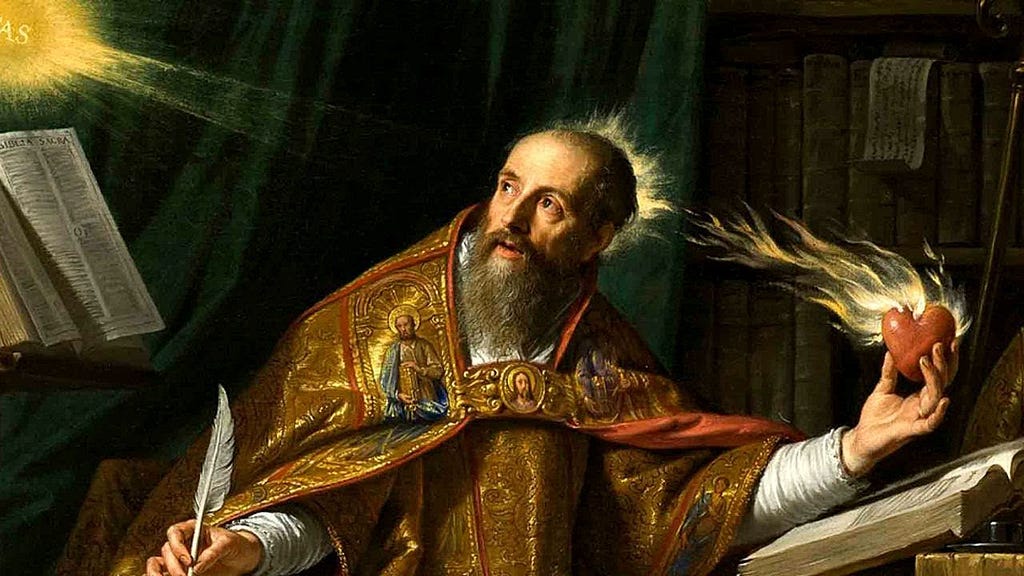
The established theological tradition of creation has run from Plato's transcendental demiurge and Plotinus' Neo-Platonic God into the Abrahamic creation narrative and Spinoza's metaphysical position of pantheism. In dealing with these theses, interalia, we may make two primary distinctions. Creatio ex nihilo, the view which holds that the material world and all matter within it is not eternal and was created by a divine act of God. Creatio ex nihilo nihhil fit, an antithesis to the above, primarily rooted in not supporting the existence of a creator deity and instead postulating that the Universe was formed from endless, primordial, formless matter.
Creation here is broadly understood as the effort by which God causes an object to exist. Therefore, creating the cosmos necessarily implies bringing it from a state of non-being into one of being, which does not permit a transformation of pre-existing substances production ex materia where the word creation would then be inappropriate. Then, it is clear that the question presupposes a logical basis primarily grounded in ex nihilo theologies since any theory of eternal matter posits that God did not, strictly, create the Universe. Instead, one would rather consider him as a divine architect of some sort (Plato's demiurge, for example). Answering this question then obviously presupposes the statement "God created the cosmos." However, there exists sufficient debate to support that there is no clear answer to the problem of cosmic origin. Then, we may not concede so easily that God did indeed create the cosmos. In showing otherwise, we reduce the question to a matter of redundancy for if God were not the Creator, then the Abrahamic question falls prey to absurdity.
Granted the rigor, precision, and interconnectedness of theological and metaphysical views concerning creation, we will consider them, to the fullest extent possible, in a linear fashion. It must be subsequently noted that the answer to the question is not an absolute one since it largely depends on individual interpretation of translated scripture and is incomplete at the expense of contingent views. It is nonetheless our aim to consider the full theological treatment of creation theories to, at the very least, provide a relative resolution to the question.
Ancient views of creation
The dogma of ex nihilo creation is not reflected in early Sumerian or Bablyonian mythologies. The Sumerian Creation of the Pickax supports this eternal matter view, proposing the origin of the cosmos in the separation of the heaven from the Earth. The Babylonian creation epic Enûma Eliš similarly supposes an eternal chaos consisting of Abzû (fresh-water) and Tiamat (salt-water) from which the diety Marduk created Heaven and Earth. Unlike the Sumerian epic, Enûma Eliš goes further in its active consideration of what happened before the divine act of Marduk: a conflict between Marduk and the forces of chaos unravels to result in the production of the cosmos. As far as the ancient Egyptians are concerned, study of Papyrus Leiden I 350 and Utterance 80 of the Coffin Texts, show that they did not have a concept of matter as the later Greeks did but there still remains no evidence of any ex nihilo thought arising here.
Whether primordial matter with the Pre-Socratics, the notion of the δημιoνργος (Artificer of the Universe) in Plato's Timaeus, or Prime Matter in Aristotle's Metaphysics, the Greeks all demonstrate a marked idea of some ex materia creation of the cosmos. It is almost a truism to contest that the process of creation described in the Timaeus is not to be conceived in the sense of time. Rather, the demiurge appears as some form of an Eleatic unity. It is also worth recognizing that it is not strictly correct to conflate the demiurge with the idea of God Himself since he is not omnipotent but is rather limited in creating the cosmos from pre-existing chaotic matter. However, because Plato's demiurge is a striking parallel to the Judeo-Christian God, I will concede this transgression for the sake of theological argument. Further, Plato notes that as beings incapable of divine knowledge and transcedence, we may not possibly know the answer to this question. This is similar to some Gnostic views developed later.
Timaeus: And amid the variety of opinions which have arisen about God and the nature of the world we must be content to take probability for our rule, considering that I, who am the speaker, and you, who are the judges, are only men; to probability we may attain but no further.
In the Timaeus, the cosmos is thought to be the result of self-evolution of some absolute thought wherein there can be no discernibility between mind and matter for all that exists is the mind. Plato's system then ends in a distinct form of pantheism, and any attempt to consider notions of "before the cosmos" is futile since creation appears to be a process independent of both time and space. Similarly, Aristotle's exploration in Physics Book I shows a manifest contradiction ultimately concluding that the cosmos has existed eternally. Parmenides' dictum ex nihilo nihil fit first appears in the same work and similar views were expressed by Lucretius in De Rerum Natura: "that nothing's brought Forth by any supernatural power out of naught… Nothing can be made from nothing." Lucretius also remarks tanta stat praeidta culpa in support of the same argument, maintaining that were the world to have been made by gods, there would not be so many things wrong with it. It is worth noting, however, that Aristotle's work deals with teleological analysis and it was not he who was tasked with converting this into a cosmogony of any sort — that was the work of the reception. This position of eternalism does not offer one the privilege of invoking any notion of God or creation. In all theological polemics, perhaps, the Epicureans were most likely to concern themselves with the eternalist view. Epicurean physics rejected any divine involvement in the creation of the cosmos since any evidence of it is derived from senses of the mind; so, as Epicurus notes, "if nothing existed, no concept of the world would be found in the minds of the gods."
These creation theses go insofar as demonstrating how the earliest views of what one may consider ancient theology were grounded in the basis of primordial eternal matter and the concept of "something out of nothing" was foreign; it may be argued by the creationists that the infancy of cosmogonies relating to the early civilizations further suggests that theological thought was not sufficiently sophisticated to provide a rigorous and precise answer concerning our question. To this, I contest that the views of the Greeks were built in a manner to appease to logic. The Abrahamic creation narrative seems to be host to sufficient inconsistencies for us to side with the Greeks for now.
The Judaeo-Christian Narrative
According to the tafsirs (the exegises) of the Quran, Islam acknowledges three types of creation. ex nihilo in time, emanation, and productio ex materia. Given the rigor and grandness of the arguments supporting all three views, we do not wish to indulge ourselves in the problem of which one is accurate. So, instead, we will restrict ourselves to the Judaeo-Christian concept of God and interpretation of the Genesis.
In the beginning, God created the heaven and the Earth
Bereshit bara Elohim et hashamayim ve'et ha'aretz.
Genesis 1:1 forms the basis of ex nihilo thought emerging in Judaeo-Christian doctrine of creation. Some scholars still support this view, while others believe, on exegical grounds, that the Book of Genesis is not strictly concerned with the origin of matter. The problem of interpreting the transliteration is not of immediate concern here. Instead, we espouse the views of the former (as done by Aquinas and St. Augustine, along with other Christian Fathers) in saying that the Genesis supposes an ex nihilo creation.
Some people, in order to discover God, read books. But there is a great book: the very appearance of created things. Look above you! Look below you! Note it. Read it. God, whom you want to discover, never wrote that book with ink. Instead He set before your eyes the things that He had made. Can you ask for a louder voice than that? Why, heaven and earth shout to you: "God has made me!"
— Sermon 126.6, Saint Augustine
Inspired from Plotinus' Enneads and Plato's Timaeus, it can be contested that the question, even in the Judaeo-Christian sense, remains improper since one could equally argue that time was itself created at the beginning of the cosmos. In fact, our understanding of time only dates to as far as back the Universe existed, for one cannot subsist without the other. This can be credited to the very nature of time being rooted in an experience of change; as Aristotle notes in Physics, time is "a number of change with respect to the before and after." So, the lack of a "before" is sufficient in determining the lack of time, since the existence of both a before and an after are necessary for our experience of time. My view is contested by those that believe the question itself is a futile effort since Man is restricted by divinity. Similar to Plato's views, this is reflected in Adverses Haereses by Irenaeus:
If, for instance, anyone asks, "What was God doing before he made the world?" we reply that the answer to such a question lies with God himself. For that this world was formed perfect by God, receiving a beginning in time, the Scriptures teach us: but no scripture reveals to us what God was employed about before this event.
This emphasis on unknowability and incomprehensibility of the divine is reflected throughout Gnostic, Christian, and Jewish theology. The question then dissolves into a manner of incapability and is not satisfying to the theologist. This is, in some senses, a trivial resolution. Perhaps, as is noted by some earlier thinkers, one could say God was resting before creation. However, if one does concede that God had rested before creating our cosmos, why did He not continue to rest? To this, I would argue, as done by Origen in Book III of the Peri Archon, "it is alike impious and absurd to say that God's nature is to be at ease and never move." Further, unlike Irreaneus' admission of impropriety, Origen does pursue an answer in saying that before creation of this world, there existed others and God may have been presumably involved in them. However, it could be rather easily be contested that this is solely a product of his own speculation as there appears no record in Scripture of worlds before or after ours.
In all, I contend that even espousing the Judaeo-Christian narrative of creation only leads one to either an inability to answer or an answer that suggests time could not have existed before the cosmos. If considering an ex materia view, it is then also apparent that the question is a manifest absurdity since God did not create the cosmos and so it is futile to ask what He did before it. So, I concede that the question remains futile not because we cannot know but because it is grounded wrongly in the presumptions that either, God created the cosmos, or time existed before the ex nihilo creation of the cosmos.
As always, thank you for reading!